The Saint John River cuts right through Fredericton, and that means our soil profiles shift fast from dense glacial till to loose alluvial deposits. Winter frost penetrates deep, often exceeding 1.5 meters, so any foundation design has to account for both load transfer and freeze-thaw cycling. In our experience, driven pile design here demands a thorough understanding of how those layers behave under dynamic driving conditions. Before we even pick a hammer size, we run a subrasante vial assessment to map bearing layers and avoid settlement surprises. That upfront work saves weeks of rework later.
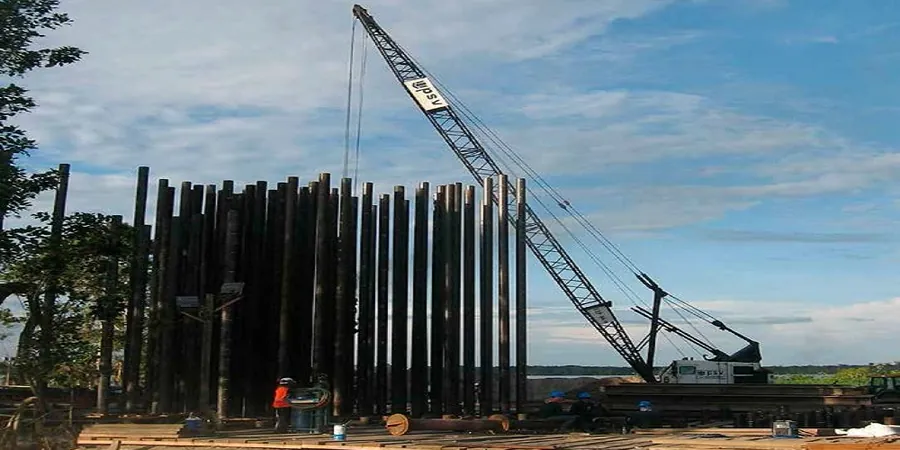
Glacial till at 8 meters depth can provide over 200 kPa end-bearing, but only if driving criteria account for the overlying loose alluvium.
Technical details of the service in Fredericton
Typical technical challenges in Fredericton
Fredericton sits on the banks of a river that floods every spring, and those high water tables can turn a simple driven pile design into a bearing-capacity headache. Loose saturated sands may liquefy under dynamic loading if not densified first. We’ve seen projects where ignoring the pore pressure buildup during driving led to pile refusal at half the target depth. That’s why we always run a dissipation test after driving and correlate with CPTu data. It’s not just about capacity — it’s about knowing the ground won’t settle a year later.
Our services
Beyond driven pile design, we cover the full geotechnical cycle in Fredericton — from site investigation to construction monitoring.
Geotechnical Site Investigation
Boreholes, SPT, and CPTu to characterize stratigraphy and groundwater conditions before any pile design begins.
Dynamic Load Testing (PDA)
High-strain testing per ASTM D4945 to verify capacity and driving stresses during production piling.
Wave Equation Analysis (WEAP)
Numerical modeling to optimize hammer selection, cushion stiffness, and driving criteria for each pile type.
Pile Installation Supervision
On-site monitoring of driving logs, set criteria, and refusal checks to ensure design assumptions hold in the field.
Frequently asked questions
What are the typical driven pile types used in Fredericton?
We most often specify precast concrete and steel H-piles. Concrete piles work well in the dense till for end-bearing; steel H-piles are preferred when driving through the alluvial sands and clay because they can handle higher driving stresses and easier splicing.
How does the Saint John River floodplain affect pile design?
Shallow groundwater and loose saturated sands create a risk of liquefaction and reduced skin friction. We account for this by designing longer piles that reach competent till, and we often require a restrike after pore pressures dissipate to confirm capacity.
What is the cost range for a driven pile design study in Fredericton?
For a typical residential or small commercial project, expect between CA$1,580 and CA$5,660. That includes boreholes, laboratory testing, and a design report with pile capacities and installation criteria. Larger projects with PDA testing or wave equation analysis fall at the higher end.
Do you need a wave equation analysis for every driven pile job?
Not always, but we recommend it for piles longer than 30 meters or when driving through variable soils. It helps predict driving stresses and prevents pile damage. For straightforward projects in uniform till, standard static capacity calculations are usually sufficient.