Fredericton sits on the Saint John River floodplain, underlain by glacial till and silty sands. The water table sits shallow in many lots, often between 1.5 and 3 meters. That makes the Standard Penetration Test our go-to method for estimating relative density and strength in these granular soils. We run the SPT in strict accordance with CSA A23.2-9A / CSA A23.2-9A / CSA A23.2-9A / CSA A23.2-9A / CSA A23.2-9A / ASTM D1586, recording blow counts every 300 mm. The N-value we obtain directly informs bearing capacity and liquefaction screening. Before any deep foundation design on the south side of town, we always recommend pairing the SPT with a stability analysis for retaining walls when excavations border slopes or adjacent properties.
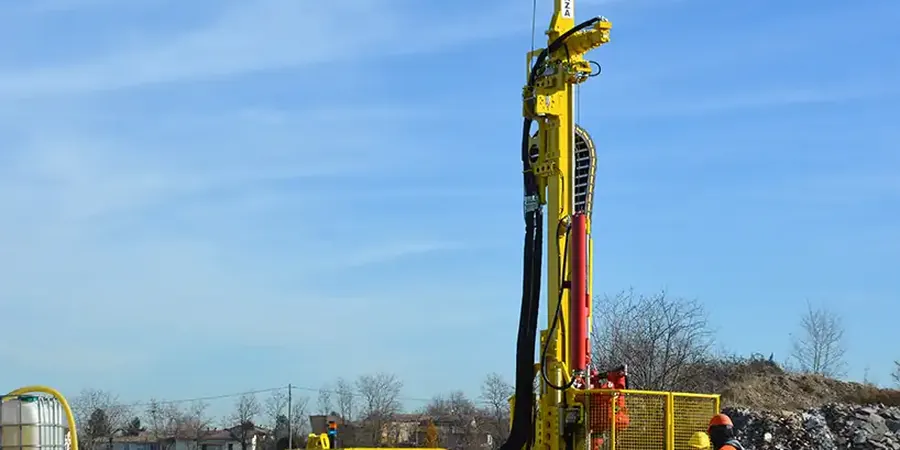
In Fredericton’s glacial till, SPT N-values typically range from 8 to 35, with lower counts near the river and higher counts on the north side uplands.
Technical details of the service in Fredericton
Typical technical challenges in Fredericton
NBCC 2020 mandates site classification based on VS30, but for non-seismic projects in Fredericton, the SPT-based method (NCEER 1997) remains the primary tool for liquefaction assessment. The risk is real: loose, saturated sands along the Saint John River can lose strength during a moderate seismic event. We flag any zone where N1,60 drops below 15 at depths between 3 and 10 metres. That triggers a deeper evaluation with cyclic triaxial testing to confirm the susceptibility. Ignoring these borehole results has led to differential settlement in several commercial buildings near the riverfront. We document every correction factor so the geotechnical engineer has a clear audit trail.
Our services
We offer a complete SPT service package that covers the entire field-to-report cycle in Fredericton.
Conventional SPT in Glacial Till
Split-spoon sampling every 1.5 metres with automatic trip hammer. Full energy calibration and rod-length correction included. We deliver N60 and N1,60 values with a summary log.
SPT with Continuous Sampling
For soft silty sands near the river, we combine the SPT with continuous Shelby tube sampling in the same borehole. This gives both blow count and undisturbed specimens for lab testing.
Seismic SPT (SPT-VS Correlation)
We use the Ohta-Goto correlation to estimate VS30 from N-values when a geophysical survey is not budgeted. Useful for NBCC site class assignment on smaller projects.
Frequently asked questions
How much does an SPT borehole cost in Fredericton?
The typical range for a single SPT borehole to 10 metres depth is CA$670 to CA$1,180. This includes mobilisation, drilling, sampling, and a basic log. Volume discounts apply for multiple holes.
Can SPT detect liquefaction risk in Fredericton soils?
Yes. We apply the NCEER 1997 method using corrected N1,60 values. Loose saturated sands with N1,60 below 15 are flagged for further cyclic testing. The river terrace deposits are the primary concern.
What is the difference between raw N and N60?
Raw N is the blow count measured in the field. N60 corrects that value to a standard energy ratio of 60%, accounting for hammer type, rod length, borehole diameter, and sampler liner. We always report both.
Do you provide SPT services in winter when the ground is frozen?
Yes, but we pre-auger through the frost zone (up to 1.8 m) before starting the SPT. We note the frost depth on the log so the engineer can assess any impact on the upper N-values.