Fredericton's urban expansion, particularly along the Saint John River corridor, has increased demand for deep foundations on variable alluvial deposits. The city's historic downtown sits on terraced glacial till, while newer developments extend onto softer floodplain silts. Understanding whether a pile will carry load through skin friction or end bearing becomes critical when designing for these contrasting profiles. In our experience, the transition from dense till to loose river sediments can happen within meters, making a site-specific analysis essential. Before specifying pile type, we often recommend a complementary deep soil mixing treatment to improve weak upper layers, or a permeability field test to assess drainage around the shaft.
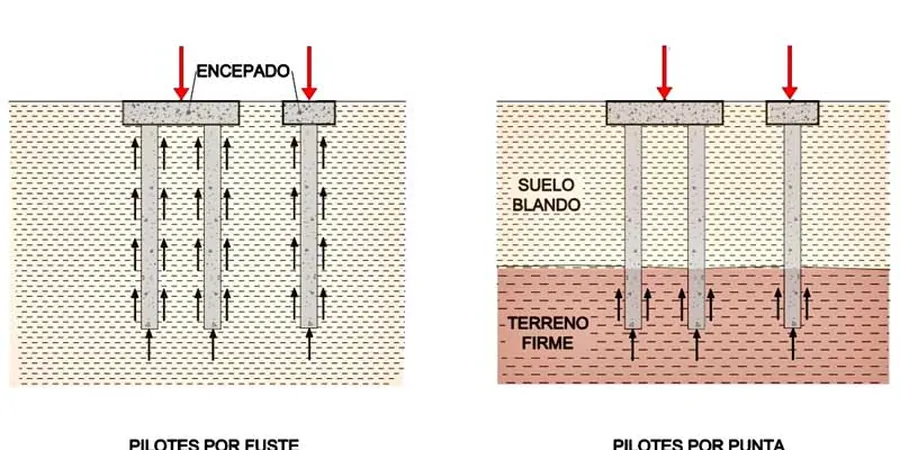
The transition from dense till to loose river sediments can happen within meters, making a site-specific pile analysis essential in Fredericton.
Technical details of the service in Fredericton
- Borehole logging to identify soil layers and groundwater depth
- CPT or SPT profiles to estimate unit shaft resistance and tip resistance
- Finite element modeling for piles in layered strata
Typical technical challenges in Fredericton
In Fredericton, the contrast between the downtown till plateau and the south-side floodplain creates a split in foundation behavior. Piles on the till side often reach refusal in dense sand within 10–15 meters, relying mostly on end bearing. On the floodplain, soft silts and organic clays can extend 20+ meters, forcing the pile to develop almost all resistance through skin friction. If the friction component is overestimated in these saturated layers, long-term creep settlement becomes a real risk. We have seen projects where ignoring the difference between drained and undrained shear strength in the skin friction calculation led to 40% more settlement than predicted.
Our services
Our team provides a full suite of pile analysis services tailored to Fredericton's subsurface variability. Each service includes a written report with load-settlement curves, factor-of-safety calculations, and recommendations for pile type and installation method.
Static Load Test Interpretation
We analyze maintained-load and quick-test data per ASTM D3966, separating shaft and base resistance using Davisson's offset method and Chin-Kondner extrapolation.
CPT-Based Shaft & Tip Resistance
Using cone penetration test data, we apply the UWA-05 and LCPC methods to estimate unit skin friction and end bearing in sand, silt, and clay layers.
Finite Element Modeling (FEM)
We run 2D and 3D axisymmetric models in Plaxis or Abaqus to simulate pile-soil interaction under working and ultimate loads, including group effects.
Bearing Capacity Verification (NBCC 2020)
We verify that factored geotechnical resistance at both shaft and tip exceeds factored loads, using the ULS and SLS limit states defined in the code.
Frequently asked questions
What is the difference between skin friction and end bearing in pile design?
Skin friction is the load transferred along the pile shaft through shear resistance between the pile surface and the surrounding soil. End bearing is the load transferred at the pile tip to a competent bearing stratum. In Fredericton, piles in the downtown till often rely primarily on end bearing, while those on the floodplain depend mostly on skin friction through the soft silts.
How does the Saint John River floodplain affect pile skin friction values?
The floodplain's soft silts and organic clays have low undrained shear strength (typically 15–30 kPa), which limits the unit shaft resistance to about 20–40 kPa. Seasonal groundwater fluctuations can further reduce effective stress and lower the friction capacity. Our analysis applies a reduction factor of 0.6–0.8 for saturated conditions as recommended by NBCC 2020.
How much does a pile skin friction vs. end bearing analysis cost in Fredericton?
A complete analysis typically ranges from CA$1,590 to CA$3,690, depending on the number of pile locations, the depth of investigation, and whether CPT or SPT data is already available. This includes the written report with load-settlement curves and a factor-of-safety summary.