Fredericton sits on the Saint John River floodplain, where silty and clayey soils dominate much of the urban area. High water tables and seasonal freeze-thaw cycles soften these deposits, making untreated subgrades prone to settlement and frost heave. Lime and cement stabilization chemically alters the soil matrix, reducing plasticity and increasing bearing capacity. Before we design the mix, we always run a permeability field test to gauge drainage behavior and adjust binder dosage accordingly. It is a practical step that saves time later.
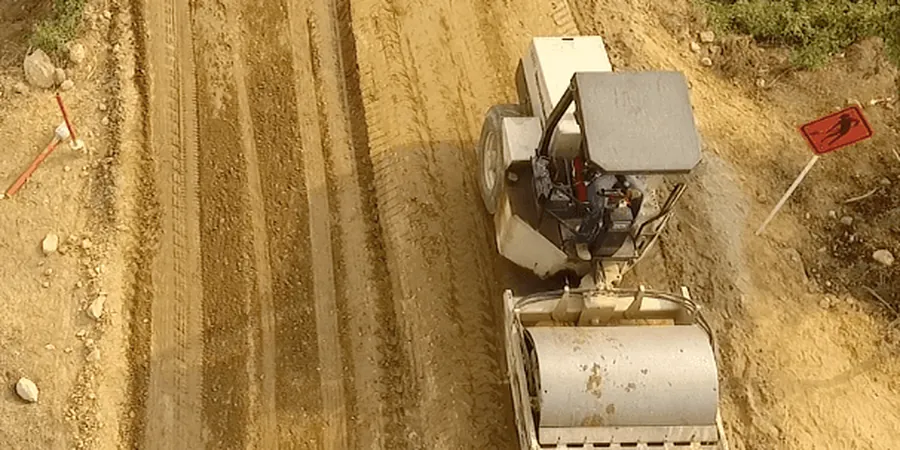
Lime and cement stabilization transforms Fredericton's frost-susceptible silts into a load-bearing subgrade, reducing plasticity and controlling heave under seasonal freeze-thaw.
Technical details of the service in Fredericton
Typical technical challenges in Fredericton
New Brunswick's Building Code (NBCC 2020) and CSA A23.3 set minimum subgrade performance criteria for structures in Fredericton. The most common failure we see is differential heave caused by uneven lime distribution in wet silts. If the mellowing period is cut short, unreacted lime pockets remain, leading to soft spots. We also watch for delayed ettringite formation in sulfate-bearing soils—a risk that can crack stabilized layers months after placement. Proper mixing depth and moisture control are non-negotiable.
Our services
We cover the full stabilization workflow—from soil characterization through mix design verification. Below are the specific services we deliver in Fredericton.
Soil Classification for Stabilization
Atterberg limits, grain-size analysis, and natural moisture content to determine binder type and dosage.
Mix Design & Laboratory Testing
Unconfined compression, pH testing, and durability cycles per ASTM protocols for each project's target strength.
Field Application Supervision
On-site control of spreading depth, mixing uniformity, moisture adjustment, and compaction during lime or cement application.
Post-Stabilization QA/QC
In-situ density tests, core sampling, and 7/28-day strength verification to confirm compliance with design specs.
Frequently asked questions
What types of soil in Fredericton respond best to lime and cement stabilization?
Silty clays (CL, CH) and silty sands (ML, SM) from the Saint John River floodplain are the most responsive. Lime works well on high-plasticity clays; cement is preferred for silty sands with low plasticity. We always run preliminary classification tests before recommending a binder.
How long does the stabilization process take from testing to field application?
Laboratory mix design typically takes 5–7 business days. Field application depends on weather and site access, but a typical residential street section can be treated in 2–3 days. Curing before traffic is 7–14 days.
What is the typical cost range for lime and cement stabilization in Fredericton?
The typical range is between CA$1.260 and CA$3.010 per project, depending on soil volume, binder type, and required testing. Larger volumes reduce the per-ton cost. Contact us for a site-specific quote.