Fredericton sits at an elevation of about 20 meters above sea level along the Saint John River valley, where the subsurface is dominated by glacial till and fine-grained alluvial deposits. These soils can exhibit significant compressibility under load, especially in the older river terraces near the city core. For any mid-rise or heavy structure planned here, understanding consolidation characteristics is non-negotiable. We run the oedometer consolidation test per CSA + CSA + CSA + CSA + ASTM D2435 (also CFEM Ch 2) (also CFEM Ch 2) (also CFEM Ch 2) (also CFEM Ch 2) (also CFEM Ch 2) to measure how much and how fast a saturated clay layer will settle when stressed by a new building. This data feeds directly into calculations for total and differential settlement, preventing structural distress later. Before pouring a single footing, pairing this test with a thorough subgrade soil assessment gives you a complete picture of ground behavior, while the study of bearing capacity confirms allowable loads for your foundation system.
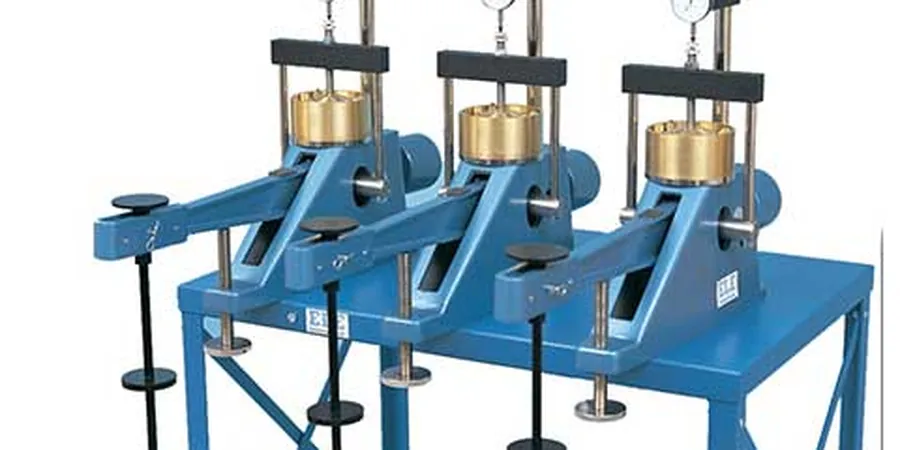
The oedometer test tells you how much a clay layer will settle and how long it takes, so you can design foundations that won't crack or tilt.
Technical details of the service in Fredericton
Typical technical challenges in Fredericton
We worked on a four-story commercial building near Regent Street where the geotechnical report from another firm only used index tests. The foundation settled nearly 40 mm in the first year, cracking the masonry facade and jamming entrance doors. The culprit was a 3-meter-thick soft clay layer that nobody had tested for consolidation. Had we run an oedometer consolidation test beforehand, the design team would have specified preloading or deep foundations. In Fredericton's river valley deposits, this scenario repeats every few years. Ignoring consolidation behavior leads to structural damage, costly repairs, and legal disputes you want to avoid.
Our services
We provide a full suite of consolidation testing services tailored to Fredericton's geological conditions.
Incremental Loading Oedometer Test
Standard CSA + CSA + CSA + CSA + ASTM D2435 (also CFEM Ch 2) (also CFEM Ch 2) (also CFEM Ch 2) (also CFEM Ch 2) (also CFEM Ch 2) procedure with load increments from 12.5 to 1600 kPa. We report settlement vs. time curves, pre-consolidation pressure, and compression indices. Typical turnaround is 10-14 days for a full curve.
Constant Rate of Strain (CRS) Consolidation Test
Faster alternative for low-permeability clays. We apply a constant strain rate while measuring pore pressure and axial stress. Ideal for sensitive soils requiring minimal disturbance.
Swelling & Collapse Potential Evaluation
Determines the swelling pressure and collapse index of expansive or collapsible soils. Essential for sites near Fredericton's river terraces where moisture changes can be significant.
Frequently asked questions
How long does an oedometer consolidation test take in Fredericton?
A standard incremental loading test with eight load steps takes 10 to 14 days from sample receipt to final report. The test itself runs continuously for 24-48 hours per load increment because we wait for primary consolidation to finish. Urgent projects can use the constant rate of strain method, which cuts the timeline to about 3-5 days.
What is the typical cost for an oedometer test in the Fredericton area?
The price for a single oedometer consolidation test in Fredericton ranges from CA$320 to CA$620, depending on the number of load increments, whether you need swelling or collapse evaluation, and the volume of samples. We recommend at least three tests per soil layer for statistical reliability. Contact us for a detailed quote based on your project scope.
How many oedometer tests do I need for a residential foundation in Fredericton?
For a typical single-family home on shallow foundations, one consolidation test per representative clay layer is usually sufficient, especially if the soil conditions are uniform. For larger or more sensitive structures, we recommend at least three tests per layer to account for natural variability in Fredericton's alluvial deposits. The NBCC 2020 requires site-specific settlement analysis when compressible soils are present.
What does the oedometer test measure that other tests don't?
The oedometer consolidation test measures the time-dependent compression of saturated clay under sustained load, which is critical for predicting long-term settlement. Other tests like SPT or triaxial give strength and stiffness, but they don't capture the consolidation rate or the pre-consolidation stress history. In Fredericton's river valley clays, knowing the pre-consolidation pressure is vital to decide if preloading or deep foundations are needed.