Fredericton's growth along the Saint John River has shaped a distinct geotechnical landscape, where glacial till and alluvial deposits meet engineered fill. Since the 1960s expansion, retaining structures have become essential for roadways and commercial developments. For projects requiring lateral support, our team integrates soil reinforcement with structural facing, ensuring long-term stability. We often pair MSE wall design with a subgrade analysis for pavements to verify that foundation layers can handle the imposed loads. This combined approach addresses both retaining and drainage needs, reducing future maintenance risks on Fredericton's sloping terrain.
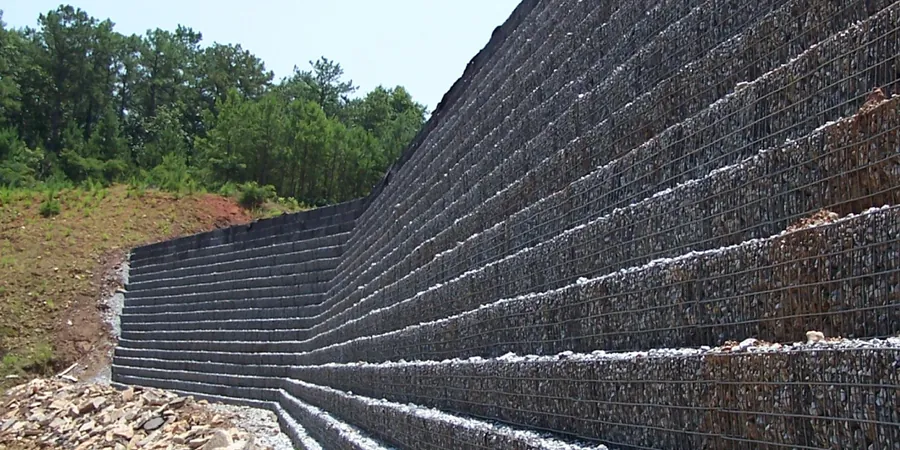
An MSE wall properly designed for Fredericton's glacial till and river deposits reduces long-term lateral movement risks by over 40% compared to conventional gravity walls.
Technical details of the service in Fredericton
- Backfill selection and compaction control per ASTM D698 (also CFEM Ch 2) (also CFEM Ch 2) (also CFEM Ch 2) (also CFEM Ch 2) (also CFEM Ch 2)
- Reinforcement strip/geogrid layout optimization
- Internal and external stability checks (sliding, overturning, bearing)
Demonstration video
Typical technical challenges in Fredericton
During a recent commercial site near Regent Street, the contractor faced unexpected lateral movement on a 7 m tall MSE wall after heavy spring rains. The backfill had been placed at moisture content above optimum, reducing shear strength. We intervened with a revised drainage design and increased geogrid length at the lower tiers. The lesson is clear: in Fredericton's humid continental climate, compaction moisture control and surface water management are not optional. An MSE wall designed without accounting for these local weather patterns can experience bulging or settlement over time, impacting adjacent infrastructure.
Our services
Our MSE wall design services cover the full scope from concept to construction support, tailored to Fredericton's geotechnical profile.
Preliminary Feasibility & Layout
We evaluate site constraints such as right-of-way limits, existing utilities, and soil bearing capacity. For Fredericton's narrow urban corridors, we optimize wall geometry to minimize excavation while meeting NBCC clearance requirements.
Internal & External Stability Analysis
Using limit equilibrium and finite element software, we check sliding, overturning, bearing capacity, and pullout resistance. The analysis incorporates Fredericton's seismic coefficients and groundwater levels from nearby river monitoring stations.
Drainage & Backfill Specification
We design chimney drains, weep holes, and filter layers to manage the high water table common in Fredericton's floodplain areas. Backfill gradation follows ASTM D448 to ensure free-draining conditions and long-term reinforcement durability.
Frequently asked questions
What is the typical cost range for MSE wall design in Fredericton?
For a standard project in Fredericton, the design and engineering fees range between CA$1.880 and CA$5.490 depending on wall height, soil conditions, and complexity. This includes site review, stability analysis, and construction drawings.
How long does the MSE wall design process take for a typical commercial project?
From initial soil data review to final stamped drawings, expect 3 to 6 weeks. If geotechnical investigation is needed first, add 2 weeks for drilling and lab testing. We can expedite partial reviews for permit submissions.
Can MSE walls be used on steep slopes in Fredericton's river valley?
Yes, MSE walls are well-suited for steep sites because they tolerate differential settlement better than cast-in-place walls. However, global stability analysis must consider the underlying glacial till and potential for deep-seated failure planes. We often recommend staged construction with drainage layers.
What reinforcement type works best for Fredericton's freeze-thaw cycles?
Galvanized steel strips with sacrificial thickness are preferred for high-traffic walls, while polyester geogrids with UV-resistant coating perform well in residential applications. Both materials are designed for Fredericton's 200+ freeze-thaw cycles per year, provided the backfill is properly drained to prevent ice lens formation.