During a recent excavation for a six-story mixed-use building on Queen Street in Fredericton, we encountered a persistent water table at only 2.3 meters below grade. The site, located near the Saint John River floodplain, required a tailored geotechnical drainage design to prevent hydrostatic pressure buildup against the basement walls. Before we could finalize the drainage layout, we needed accurate permeability data from the stratified silty sands and clay lenses typical of the Fredericton area. That's where our field team stepped in with in-situ tests and careful observation. We combined this with a detailed permeability field test to measure hydraulic conductivity directly in the boreholes, and then cross-referenced those results with a consolidation analysis to predict long-term settlement under drained conditions. The entire design had to account for seasonal high water levels that can rise nearly a meter after snowmelt, a reality every Fredericton geotechnical engineer knows well.
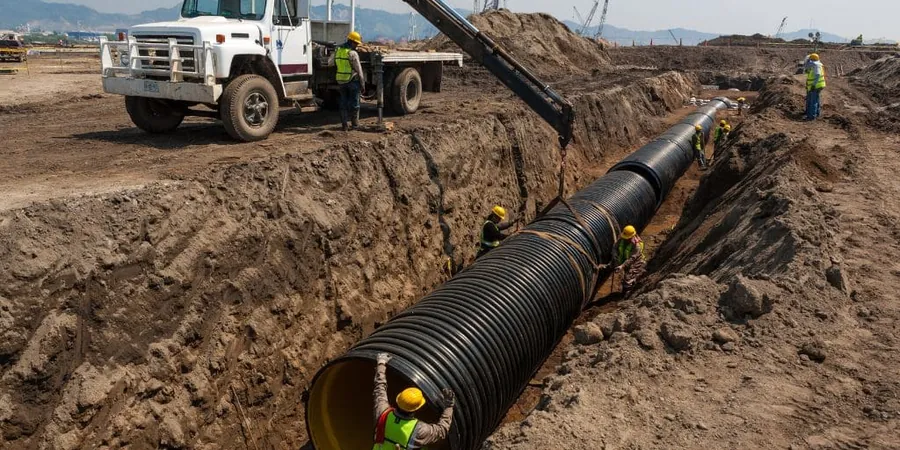
In Fredericton's river-adjacent soils, ignoring seasonal groundwater rise can double hydrostatic pressure on basement walls within days.
Technical details of the service in Fredericton
- We calculate flow rates using Darcy's law and design filter layers with properly graded granular material.
- Each drainage system is modeled for both steady-state and transient conditions, following the NBCC 2020 groundwater chapter.
- We always recommend a secondary contingency such as a sump pump system for extreme rainfall events.
Typical technical challenges in Fredericton
The biggest risk in Fredericton's geotechnical drainage design is underestimating the impact of the spring freshet. When the Saint John River swells from April to May, the regional water table can rise abruptly by over 1.5 meters in low-lying neighborhoods like the South End and Marysville. If your drainage system was sized only for average conditions, the sudden influx of water can overwhelm perimeter drains, saturate backfill, and exert uplift forces on your foundation slab. We have seen cases where missing a single interbedded silt layer during investigation led to water seeping through a basement floor within three years of construction. That is why our team always drills at least one extra borehole near the lowest corner of the proposed excavation to capture the worst-case groundwater scenario.
Our services
We offer two complementary geotechnical drainage design services tailored to Fredericton's conditions, each supported by field data and laboratory analysis.
Foundation Drainage System Design
We design perimeter drains, French drains, and sump systems sized for the specific permeability and water table of your Fredericton site. Our calculations include filter stability, pipe gradient, and outlet capacity to ensure long-term performance without clogging.
Slope & Cut Drainage Design
For excavations or sloping lots in Fredericton, we design horizontal drains, interceptor ditches, and blanket drains to control seepage and maintain slope stability. We model seepage paths using the local soil stratigraphy and seasonal water level data.
Frequently asked questions
Why is geotechnical drainage design important for Fredericton homes?
Fredericton sits in the Saint John River valley with shallow groundwater and silty clay soils. Without proper drainage design, hydrostatic pressure can crack foundations, cause basement flooding, and lead to differential settlement. Our designs comply with NBCC 2020 and account for the city's seasonal water table rise.
What soil tests are needed for drainage design in Fredericton?
We typically perform constant-head (ASTM D2434) or falling-head (ASTM D5084) permeability tests on undisturbed samples, plus grain size analysis to design filter layers. For deep sites, we install vibrating-wire piezometers to monitor real-time groundwater fluctuations over at least one full season.
How long does a geotechnical drainage design take?
Typical turnaround is 3 to 5 weeks from field investigation to final design report. This includes site drilling, laboratory permeability testing, groundwater monitoring, and hydraulic modeling. Rush timelines are possible for smaller residential projects.
Do you design drainage for retaining walls?
Yes. We design drainage systems for both cantilever and gravity retaining walls in Fredericton, including weep holes, granular backfill, and collector pipes. Proper drainage reduces lateral earth pressure by up to 50% and prevents wall failure during heavy rainfall.
What does a geotechnical drainage design cost in Fredericton?
A typical drainage design for a single-family home lot ranges from CA$1.140 to CA$3.620 depending on site complexity, number of boreholes, and laboratory tests required. Commercial projects with multiple piezometers and long-term monitoring fall at the upper end of that range.