A residential development along the north bank of the Saint John River in Fredericton hit a common snag last spring: a 6-meter cut slope started creeping after heavy snowmelt. The contractor had stripped the vegetation but skipped a proper slope stability analysis. Within two weeks, tension cracks appeared near the crest, and the toe began bulging. That kind of failure is avoidable. We model the shear strength, pore pressure, and stratigraphy using limit equilibrium methods before any earthwork starts. For sites with complex layering, we often pair the slope analysis with a drainage geotechnical study to understand how groundwater seeps through the till and silt layers typical of the Saint John valley.
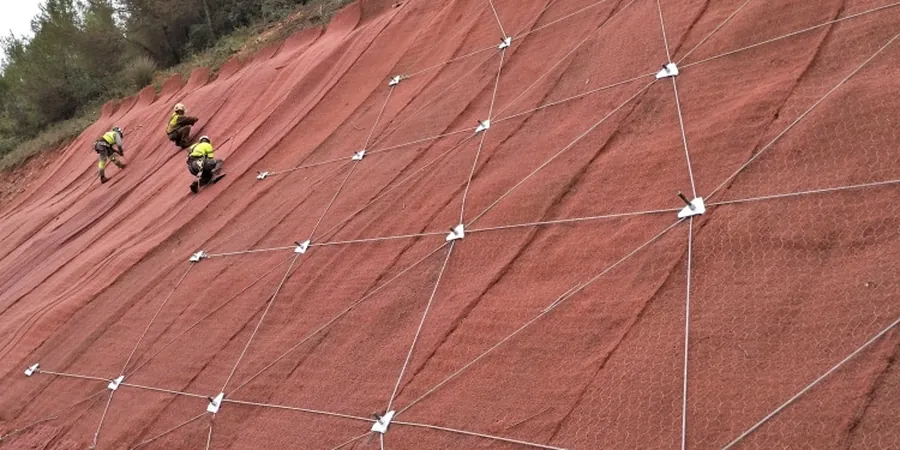
A slope that looks stable in August can be marginal in April after freeze-thaw cycles reduce soil strength by up to 40%.
Technical details of the service in Fredericton
Demonstration video
Typical technical challenges in Fredericton
NBCC 2015 and CSA A23.3 outline the minimum requirements for slope stability in Canada, but Fredericton's local geology makes these guidelines especially relevant. The silty till layers common along the riverbanks are prone to seepage-induced failures when the spring melt arrives. We have seen cases where a simple 2D analysis underestimated the risk because the failure surface followed a weak silt seam less than 30 cm thick. That is why our approach combines field investigation, laboratory testing of undisturbed samples, and numerical modeling using Spencer and Bishop methods. For any cut or fill steeper than 2H:1V in Fredericton, a proper stability study is not optional—it is the difference between a safe project and a costly repair.
Our services
We offer two core slope stability analysis services tailored to Fredericton's terrain and project scales.
Limit Equilibrium Analysis
We run Bishop simplified, Spencer, and Morgenstern-Price methods on soil profiles from test pits and boreholes. Output includes factor of safety for static, seismic, and rapid drawdown conditions. Suitable for residential lots, commercial cuts, and road embankments up to 15 m high.
Finite Element Slope Modeling
For complex stratigraphy or where seepage is critical, we use 2D finite element models (Slide2, RS2) to simulate pore pressure changes, reinforcement effects, and staged construction. This is the go-to method for large infrastructure projects in Fredericton, including bridge approaches and riverfront developments.
Frequently asked questions
How much does a slope stability analysis cost in Fredericton?
For a typical residential or small commercial site, the cost ranges between CA$1,520 and CA$6,360 depending on the slope height, number of cross-sections, and whether laboratory testing is required. Larger infrastructure projects with multiple sections and seepage modeling fall at the higher end.
What is the minimum factor of safety required by NBCC for slopes in Fredericton?
NBCC 2015 specifies a minimum factor of safety of 1.5 for static conditions and 1.1 for seismic or rapid drawdown scenarios. For critical slopes adjacent to public infrastructure, we often recommend 1.5 for all cases to account for the uncertainty in till and silt strength.
When should I get a slope stability study in Fredericton?
Any cut or fill steeper than 2H:1V, or any site where the existing slope has evidence of past movement (tension cracks, leaning trees, bulging toe), warrants a study. Also required for subdivisions, road widening, and any development within 30 m of the Saint John River or its tributaries.
Can I stabilize a failing slope without removing all the soil?
Yes, often. Options include installing horizontal drains to lower the water table, placing a reinforced soil buttress at the toe, or using soil nails and shotcrete. The best method depends on the failure mechanism and site access. We model each option to find the most cost-effective solution.