Fredericton sits in the Saint John River floodplain, where seasonal water tables can rise several meters during spring thaw. The combination of silty alluvial deposits and high precipitation — the city averages about 1,100 mm of rain and snow annually — creates persistent moisture challenges beneath road pavements. Without properly designed geotechnical road drainage, fine-grained soils lose bearing capacity, leading to premature pavement failure and costly rehabilitation. Our team evaluates in-situ permeability, groundwater fluctuations, and subgrade conditions using field tests such as permeability testing to measure hydraulic conductivity directly, ensuring that drainage layers and trench systems are sized correctly for Fredericton's specific hydrologic regime.
Spring water table rise of up to 2.5 meters in Fredericton's alluvial soils can reduce subgrade CBR by half without proper drainage design.
Technical details of the service in Fredericton
Typical technical challenges in Fredericton
We deploy a mobile drill rig with hollow-stem augers and a dedicated permeameter setup for field testing in Fredericton. Standing water in test pits — common after heavy rain — is measured continuously with pressure transducers to record short-term fluctuations. The risk of underestimating drainage requirements is particularly high in silty deposits along the river's north side, where fines content can exceed 40%. Without accurate data, a drainage system may be undersized, leading to waterlogged subbase within the first few winters. Our field crews log water levels hourly during testing and cross-check results against Fredericton's long-term groundwater monitoring wells maintained by the Department of Environment.
Our services
Our geotechnical road drainage services in Fredericton cover the entire design cycle — from field investigation to final drainage layout. Each service adapts to local soil variability and project scale.
Subsurface Drainage Design for Roads
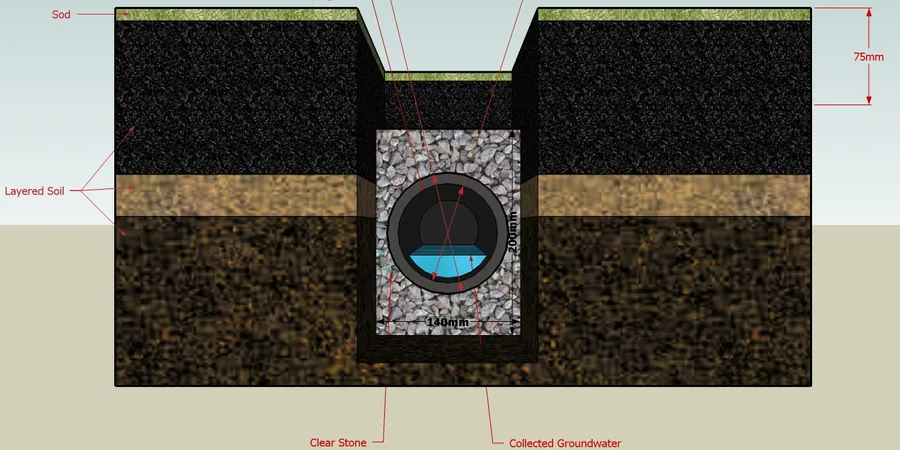
We size perforated pipe systems, granular blanket drains, and trench collectors based on measured k-values and water table data. Designs comply with NBCC 2020 and AASHTO guidelines, with filter layers selected to prevent piping in fine-grained Fredericton soils.
Permeability Testing & Groundwater Monitoring
Field falling-head and constant-head tests in boreholes and test pits, plus installation of standpipes or pressure transducers for seasonal monitoring. Data is analyzed using the Hvorslev and Bouwer-Rice methods to establish design recharge rates.
Geotextile Selection & Drainage Layer Specification
Laboratory evaluation of soil retention and permittivity criteria following ASTM D4751 and AASHTO M288. We specify woven or non-woven geotextiles based on site-specific gradation curves, ensuring clogging resistance in Fredericton's silty soils.
Frequently asked questions
Why is geotechnical road drainage critical in Fredericton?
Fredericton's location in the Saint John River valley means many roads are built on alluvial deposits with seasonal water tables that can rise 2 to 3 meters during spring. Without proper subsurface drainage, subgrade saturation reduces bearing capacity, causing rutting and pavement cracking within two to three winters.
What is the typical cost range for a road drainage study in Fredericton?
For a standard residential or collector road project, the cost for geotechnical drainage investigation and design typically falls between CA$1.300 and CA$3.280. This includes field permeability testing, groundwater monitoring, laboratory soil classification, and a detailed drainage report. Larger arterial projects or sites with deep water tables may reach the upper end of this range.
How does the NBCC 2020 affect drainage design for new roads?
NBCC 2020 requires that subsurface drainage systems be designed to handle a 1-in-10-year storm event for local roads and 1-in-50-year for major arterials. It also mandates that drainage layers extend at least 300 mm beyond the pavement edge and that geotextile separators meet the retention and permittivity criteria specified in AASHTO M288.