A common mistake we see among contractors in Fredericton is assuming the dense glacial till below the Saint John River floodplain behaves uniformly across the city. In reality, the alluvial sands along the river delta can liquefy under moderate seismic loading, while the till on the north side near Odell Park offers much higher relative density. Without site-specific vibrocompaction design, those loose pockets remain unimproved and the foundation ends up settling unevenly. We have had projects where the client skipped a proper soil investigation and later faced differential settlements of over 30 mm in a single season. Before designing any vibrocompaction grid, we always run a consolidation test to confirm the compressibility of the sand layers and a permeability field test to verify how fast pore pressures dissipate during vibration.
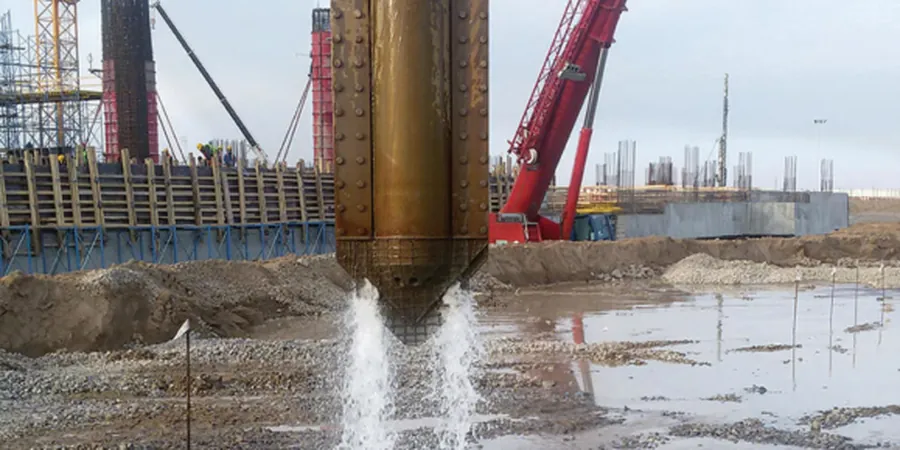
In Fredericton, loose alluvial sands below the water table are the main risk for liquefaction under NBCC 2020 seismic loads — vibrocompaction reliably eliminates that hazard.
Technical details of the service in Fredericton
Typical technical challenges in Fredericton
The contrast between the sandy soils near the Saint John River downtown and the dense till in the Marysville area is striking. Downtown Fredericton, the alluvial deposits can have N-SPT values as low as 4 blows per foot in the upper 5 m, while the till on the north side regularly exceeds 40 blows per foot. If a vibrocompaction design developed for the till is applied to the river sands, the result is either over-conservative costs or insufficient densification. We always adjust the probe depth and energy based on the specific zone, and we cross-check the final relative density with SPT testing after compaction to confirm the target is achieved.
Our services
We offer a complete set of services around vibrocompaction design in Fredericton, from initial site investigation to post-treatment verification.
Site Investigation for Vibrocompaction
Boreholes with SPT and undisturbed sampling to map the loose sand layers, determine fines content, and assess groundwater conditions before designing the compaction grid.
Vibrocompaction Design & Layout
Calculation of probe spacing, depth, energy, and sequence based on target relative density, using empirical correlations calibrated to local soils in Fredericton.
Post-Treatment Verification
CPT or SPT testing after compaction to confirm that the treated zone meets the required density and liquefaction resistance specified in the design.
Liquefaction Hazard Assessment
Evaluation of cyclic stress ratio (CSR) and cyclic resistance ratio (CRR) per NBCC 2020, using the modified SPT-based method by Youd & Idriss (2001).
Frequently asked questions
What is the typical cost of vibrocompaction design in Fredericton?
For a standard medium-size project in Fredericton, the design and verification package ranges between CA$2,160 and CA$6,100. This includes site investigation, compaction layout, and post-treatment SPT testing. The final price depends on the area to be treated and the depth required.
How deep can vibrocompaction reach in the fluvial sands of Fredericton?
In the alluvial deposits along the Saint John River, we typically treat depths between 6 m and 12 m. The maximum depth is limited by the vibrator power and the presence of dense till layers, which can stop penetration. We always verify the stratigraphy with a preliminary borehole before finalizing the depth.
Does freezing ground affect vibrocompaction in Fredericton?
Yes, frozen ground in the upper 1.8 m makes compaction ineffective because the ice matrix prevents particle rearrangement. We schedule vibrocompaction work between May and October, or we remove and replace the frost-affected layer before starting the deep compaction.
What standards govern vibrocompaction design in Canada?
The primary standard is NBCC 2020 for seismic design requirements. For the compaction methodology, we follow FHWA NHI-05-042 and CSA A23.2-9A / CSA A23.2-9A / CSA A23.2-9A / CSA A23.2-9A / CSA A23.2-9A / ASTM D1586 for SPT-based verification. The concrete foundations that rest on the improved ground are designed per CSA A23.3-19.