Working in Fredericton, we often see that the city's position along the Saint John River creates a complex mix of fluvial deposits, glacial tills, and fractured bedrock, particularly the Fredericton Formation sandstone. When clients need to understand groundwater flow for excavations or slope stability, a standard lab test just won't capture the real in-situ conditions. That is why we rely on the field permeability test (Lefranc/Lugeon) to measure hydraulic conductivity directly in the ground. Before planning dewatering systems, it is wise to combine this with an asentamiento diferencial analysis to predict how varying permeability layers may settle unevenly under load.
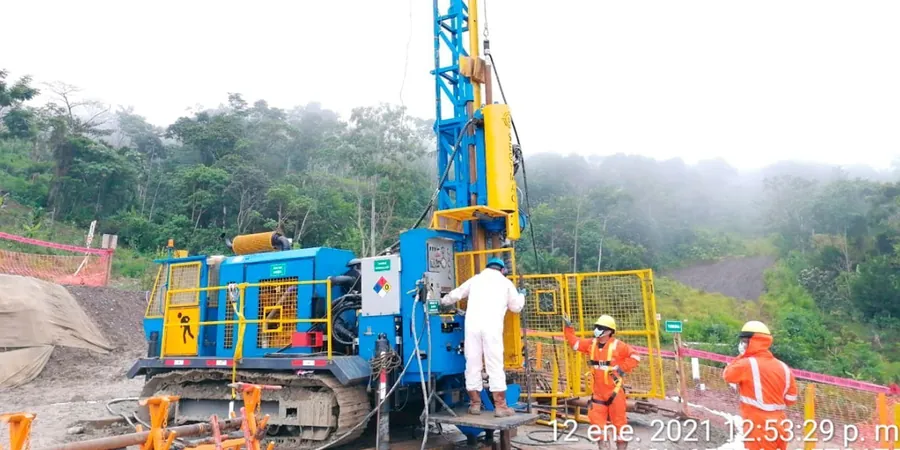
In fractured sandstone of the Fredericton Formation, Lugeon tests reveal permeability variations of up to three orders of magnitude within a single borehole.
Technical details of the service in Fredericton
Typical technical challenges in Fredericton
Fredericton's urban development over the past 50 years has expanded onto floodplains and former wetlands along the Nashwaak and Saint John Rivers. These areas often contain lenses of silty sand and organic deposits with permeability values two orders of magnitude higher than the surrounding till. Without a field permeability test, foundation designs risk underestimating groundwater inflow during construction or overestimating drainage capacity. In one case near the downtown core, a basement excavation encountered a buried channel of loose sand that had not been detected by standard borings alone, leading to a three-week delay while dewatering was redesigned.
Our services
We offer two complementary field permeability testing services adapted to Fredericton's varied geological conditions, both performed under our ISO 17025 accredited quality system.
Lefranc Permeability Test (Open Borehole)
Constant head or falling head method performed in a screened or open borehole section. Ideal for granular soils, glacial tills, and weathered bedrock where a simple, reliable K value is needed. Test duration typically 2–4 hours per depth interval.
Lugeon Packer Test (Fractured Bedrock)
Multi-stage pressure injection test using inflatable packers to isolate a test section. Measures Lugeon value and hydraulic conductivity in fractured rock masses. Essential for dam foundations, tunnel linings, and deep excavations in Fredericton's sandstone bedrock.
Frequently asked questions
What is the difference between the Lefranc and Lugeon methods, and which one should I use in Fredericton?
The Lefranc method is a constant-head or falling-head test performed in an open borehole, suitable for soils and weathered rock where the permeability is relatively uniform. The Lugeon method uses inflatable packers to isolate a specific section of bedrock and applies multiple pressure stages to characterize fracture flow behavior. In Fredericton, use Lefranc for glacial tills and alluvial sands; use Lugeon when working in the fractured Fredericton Formation sandstone, especially for deep excavations or dam foundations where fracture permeability controls groundwater inflow.
How much does a field permeability test cost in Fredericton?
For a typical project, the cost ranges from CA$950 to CA$1,630 per test depth, depending on site accessibility, borehole depth, and the method required (Lefranc is generally less expensive than Lugeon due to simpler equipment). This includes mobilization within the Fredericton area, one technician for the test duration, and a preliminary report with K values. Additional depth intervals or multiple packer tests may increase the total.
What standards govern field permeability testing in Canada?
The primary standard for field permeability testing in Canada is CAN/BNQ 2501-135 (Lefranc method) and CSA Z768 (general practice for groundwater monitoring wells). For Lugeon testing, we follow ASTM D4631 as a guideline. All results are reported in accordance with ISO 17025 requirements. The National Building Code of Canada (NBCC 2020) references these standards in Section 4.2 for foundation and groundwater control design.