Fredericton sits along the Saint John River valley at an elevation of roughly 20 meters, where the underlying geology consists of glacial till, alluvial sands, and clay layers deposited during the last ice age. These soils exhibit variable drainage and stress history, making the triaxial test essential for determining effective stress strength parameters. The city experiences a humid continental climate with average annual precipitation near 1,100 mm, so seasonal moisture fluctuations directly affect undrained shear strength. Before designing foundations or retaining structures in Fredericton, engineers rely on triaxial compression data to model how saturated soils behave under load. Combining this with a study of slope stability helps anticipate failure mechanisms in cut slopes along the riverbanks, where pore pressure build-up is a recurring concern.
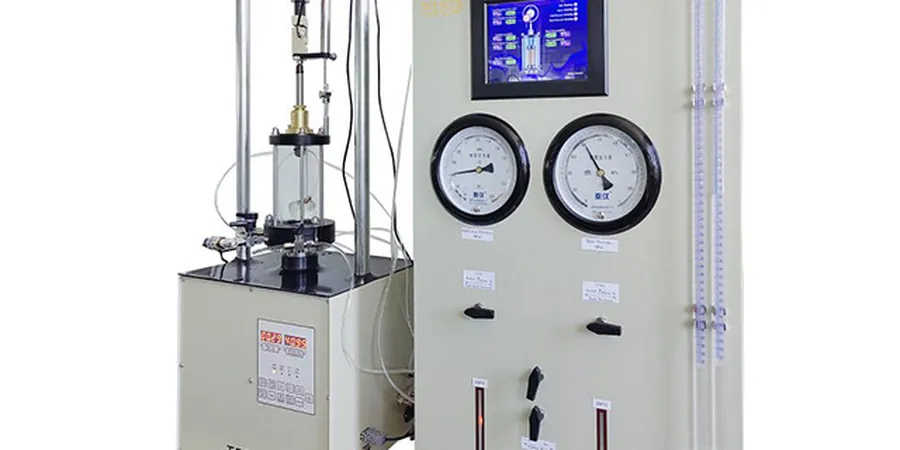
Triaxial test data from Fredericton soils show that ignoring pore pressure response can overestimate undrained shear strength by up to 30% in clay till layers.
Technical details of the service in Fredericton
- Saturation via back-pressure to a B-value of at least 0.95 before shearing.
- Consolidation under isotropic or anisotropic confining pressures matching in-situ overburden.
- Strain-controlled shearing at 0.5% per minute for UU and 0.1% for CU tests.
Demonstration video
Typical technical challenges in Fredericton
A common mistake in Fredericton construction projects is relying solely on unconfined compression test results for clay layers that appear stiff at the surface but soften rapidly upon saturation. The triaxial test reveals how these soils lose strength under confinement changes — a factor that SPT blow counts alone cannot capture. When designers underestimate the friction angle of glaciolacustrine clays, foundation settlements can exceed tolerable limits by 50 mm or more, especially near the river corridor where groundwater fluctuates seasonally. Using triaxial data calibrated to local conditions reduces this risk significantly.
Our services
Our Fredericton laboratory offers three triaxial test configurations tailored to project-specific drainage and stress conditions.
Unconsolidated-Undrained (UU) Triaxial Test
Rapid test on undisturbed samples without drainage or consolidation, yielding total stress parameters (Su) for short-term stability analysis in saturated clays and silts.
Consolidated-Undrained (CU) Triaxial Test
Samples are consolidated under in-situ confining pressures and sheared undrained while measuring pore pressure. Provides effective stress parameters c' and φ' for long-term loading scenarios.
Consolidated-Drained (CD) Triaxial Test
Full drainage during shearing at slow strain rates. Used for embankment and slope stability where long-term drained conditions govern. Applicable to sandy till layers in Fredericton.
Frequently asked questions
What is the difference between UU and CU triaxial tests for Fredericton soils?
UU tests measure undrained shear strength without consolidation, suitable for immediate stability in saturated clays. CU tests consolidate the sample first and measure pore pressure during shearing, giving effective stress parameters needed for long-term foundation design on glacial till and river deposits.
How much does a triaxial test cost in Fredericton?
The typical range for a standard triaxial test in Fredericton is CA$2,520 to CA$3,690 per test. This covers specimen preparation, saturation, consolidation, and shearing. Volume discounts apply for projects requiring multiple tests across different depths.
Which ASTM standard applies to triaxial testing in New Brunswick?
CSA + CSA + CSA + CSA + ASTM D2850 (also CFEM Ch 2) (also CFEM Ch 2) (also CFEM Ch 2) (also CFEM Ch 2) (also CFEM Ch 2) governs UU tests, ASTM D4767 covers CU tests, and ASTM D7181 applies to CD tests. All are accepted under NBCC 2020. The Fredericton laboratory follows these standards with calibration traceable to NRC Canada.