Fredericton grew along the Saint John River floodplain, and much of its downtown and newer subdivisions sit on soft alluvial deposits and glacial till. When the city extended its sewer trunk mains in the 1990s, crews hit saturated silts and organic clays that turned open-cut excavation into a nightmare. That experience taught us something: tunneling through these low-strength soils demands a different analytical approach. We perform geotechnical analysis for soft soil tunnels using borehole data, piezocone soundings, and lab testing calibrated to local stratigraphy. Before we recommend a tunnel alignment, we check what lies beneath with a detailed deep soil mixing assessment and a review of existing instrumentation records from nearby projects.
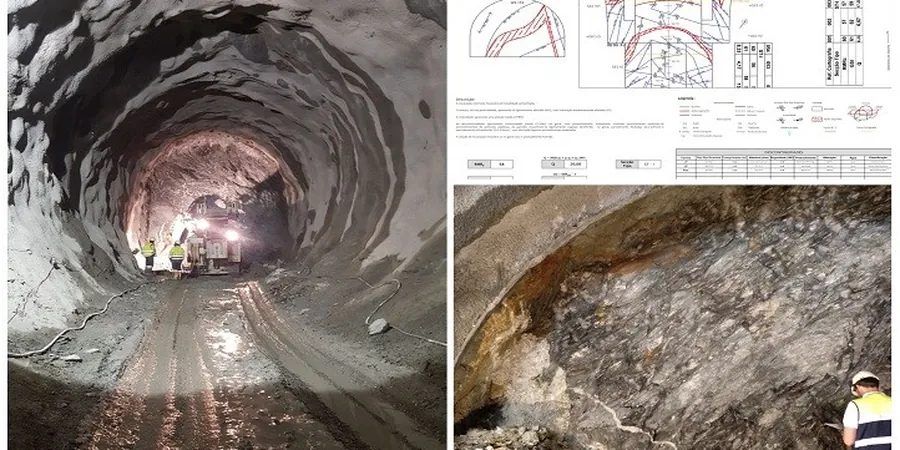
Tunneling through Fredericton's varved clays and loose sands requires undrained shear strength profiles and consolidation data to prevent face instability and long-term settlement.
Technical details of the service in Fredericton
Typical technical challenges in Fredericton
Compare downtown Fredericton near Officers' Square with the Brookside Drive corridor. Downtown sits on compact glacial till with decent bearing capacity; Brookside crosses backswamp deposits and old river channels where the topsoil is practically peat. In those soft ground zones, tunnel face collapse is the primary risk. We see it happen when contractors underestimate the sensitivity of the clay or ignore pore pressure buildup during excavation. Our geotechnical analysis for soft soil tunnels includes numerical modeling of face stability using the Pi method and support pressure calculations. We also flag the danger of long-term consolidation settlement above the tunnel crown, especially where the soil has a high plasticity index. A consolidation analysis and a permeability field test help quantify those risks before a single bucket of spoil is removed.
Our services
We bundle three complementary services under the umbrella of geotechnical analysis for soft soil tunnels. Each addresses a specific phase of tunnel design and construction in Fredericton's challenging ground.
Subsurface Investigation & Soil Profiling
Boreholes with SPT and Shelby tube sampling at 10–15 m spacing along the tunnel alignment, plus CPTu soundings for continuous stratigraphy. We log soil types, measure groundwater levels, and collect undisturbed samples for lab testing.
Numerical Modeling & Face Stability Analysis
Finite-element and limit-equilibrium models using Plaxis 2D and Slide. We calculate required face support pressure, surface settlement troughs, and lining loads for both EPB and slurry shield TBM methods.
Liquefaction & Settlement Hazard Assessment
Seed & Idriss simplified procedure with NCEER corrections for SPT-based liquefaction evaluation. We also run 1-D consolidation analysis to predict long-term settlement above the tunnel crown and recommend ground improvement if needed.
Frequently asked questions
Why is soft soil tunneling in Fredericton more challenging than in other Canadian cities?
Fredericton's alluvial deposits along the Saint John River include varved clays with high sensitivity and loose sands with low relative density. The high water table combined with seasonal freeze-thaw cycles creates heterogeneous ground conditions that produce erratic SPT blow counts and variable undrained shear strengths. A standard soil profile from one borehole rarely matches the next one 20 meters away.
What is the typical cost range for a geotechnical analysis for soft soil tunnels in Fredericton?
For a typical tunnel project in Fredericton, the geotechnical analysis scope (boreholes, lab testing, numerical modeling, and reporting) falls between CA$6.080 and CA$21.120. The final number depends on tunnel length, number of boreholes, depth of investigation, and whether advanced tests like resonant column or cyclic triaxial are required.
How do you determine the required face support pressure for a soft ground tunnel?
We use the Pi method from the FHWA manual and calibrate it with site-specific undrained shear strength and total unit weight. The analysis considers overburden stress, groundwater pressure, and a safety factor of 1.5. We also run 2D finite-element models to check that the selected pressure keeps surface settlements under the project's specified limit, typically 25 mm for urban areas.
Can you perform the analysis if the tunnel alignment crosses both soft clay and stiff till?
Yes. We divide the alignment into ground-condition zones based on borehole logs and CPTu profiles. Each zone gets its own set of parameters: undrained shear strength for the clay layers, effective friction angle for the till, and stiffness values for both. The numerical model transitions between zones at the boundaries, and we verify the transition zones with additional boreholes spaced at 15 m.
What standards do you follow for liquefaction assessment in Fredericton's soft soils?
We follow the NCEER 2001 workshop procedure (Youd & Idriss) for SPT-based liquefaction evaluation, compliant with NBCC 2020 seismic provisions. Fredericton falls under seismic hazard category with PGA between 0.1g and 0.2g. We classify the site class per NBCC 2020 Table 4.1.8.4.A using measured VS30 from MASW or correlated from SPT N-values, and we compute factor of safety against liquefaction for each soil layer.