Fredericton sits on glacial till and alluvial deposits along the Saint John River, conditions where geogrid specification must follow NBCC 2020 and ASTM D6637. These soils can shift under load if not properly reinforced. A tailored geogrid specification defines aperture size, tensile strength, and creep resistance for each project. Before finalizing the design, engineers often pair it with a drenaje vial study to manage subsurface water, or a subrasante vial analysis to verify subgrade modulus. Getting the specification right from the start prevents differential settlement and extends pavement life in Fredericton's freeze-thaw cycles.
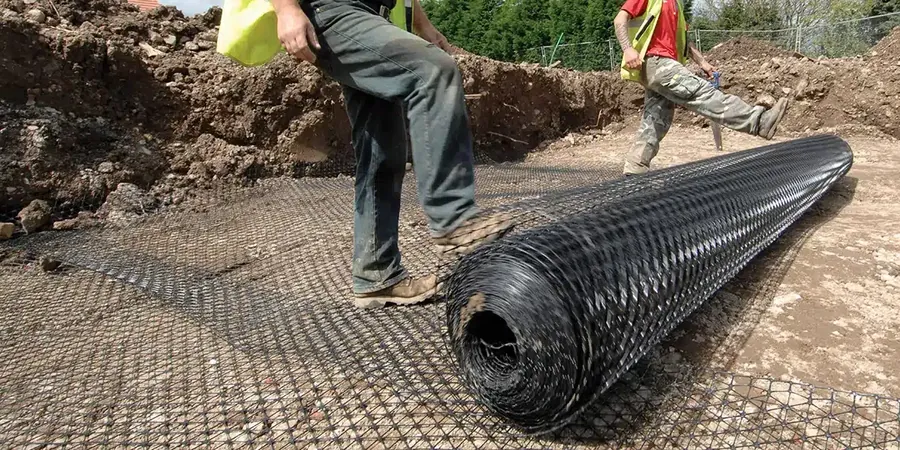
A geogrid specification without site-specific interface friction is just a guess. Fredericton's glacial tills demand measured values.
Technical details of the service in Fredericton
- Ultimate tensile strength (kN/m at 2% strain)
- Junction efficiency (≥90% per GRI-GG2)
- UV resistance for exposed installation periods
- Soil-grid interface friction angle
Typical technical challenges in Fredericton
A common mistake in Fredericton is using a generic geogrid specification from a southern Ontario design. The city's freeze-thaw cycles and saturated silts require grids with low creep and high junction stiffness. If the specification ignores frost heave potential, the reinforcement can lose tension over winter. Contractors who skip interface friction testing often face pavement rutting within two seasons. A proper geogrid specification for Fredericton must account for long-term durability against ice lensing and chemical attack from road salts.
Our services
We provide two complementary geogrid specification services tailored to Fredericton's geology and climate.
Bearing Capacity Improvement Specification
Design of biaxial geogrids for soft subgrades under roads and parking lots. Includes interface friction testing and fill thickness optimization per FHWA guidelines.
Slope & Retaining Wall Reinforcement Specification
Uniaxial geogrid design for steepened slopes and MSE walls. Accounts for Fredericton's riverbank stability and seismic loads per NBCC 2020.
Frequently asked questions
What ASTM standards apply to geogrid specification in Fredericton?
The key standards are ASTM D6637 for tensile strength, ASTM D5262 for creep, and ASTM D5321 for soil-geogrid interface friction. NBCC 2020 also sets requirements for long-term design strength.
How does Fredericton's climate affect geogrid selection?
Freeze-thaw cycles weaken soil structure, so grids must have low creep (reduction factor ≤1.5) and high junction efficiency. UV resistance is also critical since installation often occurs in exposed conditions for weeks.
What is the typical cost range for a geogrid specification study?
The cost for a site-specific geogrid specification in Fredericton usually falls between CA$560 and CA$1.940 depending on project complexity, number of soil layers, and required testing.
Can geogrids replace deep foundations on soft soil?
Geogrids improve bearing capacity but do not replace deep foundations for heavy structures. They work best for roads, retaining walls, and light fills. Always combine with asentamiento-diferencial analysis to verify total settlements.